
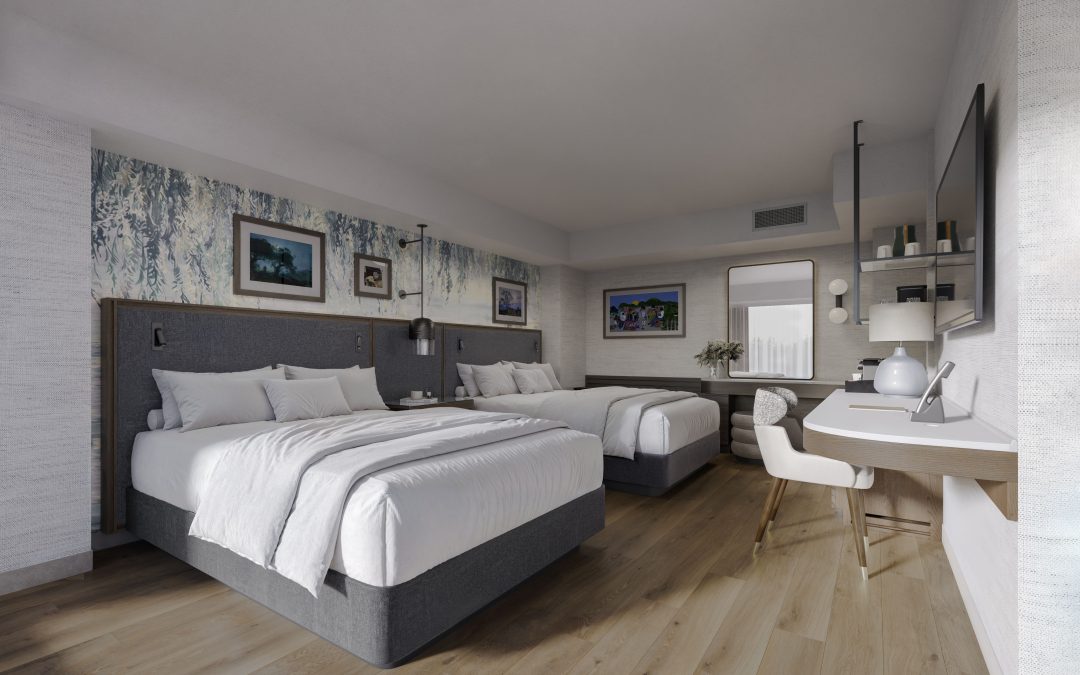
Marriott hotel visualization — Radical Galaxy Studio
We do a lot of different kinds of work multifamily, single-family, office, mixed-use. Each has its own challenges. But if you ask anyone on our team which projects keep them up at night, the honest answer is hospitality.
Not because it’s technically harder, exactly. It’s that the margin for error is different. Most hospitality renderings look right and still fail, because they don’t capture atmosphere. A residential rendering that’s 90% right still communicates the floor plan, the finishes, the general feel of the space. A hospitality rendering that’s 90% right can miss the entire point because what you’re actually selling isn’t a room. It’s a feeling. And in hospitality, that feeling is what determines whether someone books or scrolls past, whether a flag partner approves or sends it back, whether an investor sees a premium property or just another hotel.
This is what we’ve figured out working on projects for Marriott, boutique resort developers, and F&B operators. And it’s why Unreal Engine changed the game for us in ways that go beyond the obvious.
What Makes Hospitality Visualization Different
The challenge isn’t unique to rendering it’s the same challenge hospitality designers deal with in the physical world. A hotel isn’t a building you live or work in. It’s a carefully constructed experience. Every material choice, every lighting decision, every piece of furniture placement is in service of a specific emotional register. Intimate. Energetic. Calm. Luxurious without being cold. The design has a mood, and the visualization has to capture that mood or the whole thing falls flat.
Atmosphere doesn’t render automatically
A physically accurate rendering of a hotel bar can still look like a 3D model of a hotel bar rather than an actual bar you’d want to spend time in. The difference is in how light behaves at that specific hour, the warmth of the materials, the sense that people have been here and will be here again. That’s not something you get from dialing in the right roughness map. It’s a judgment call that takes time to develop.
The brief is usually emotional, not technical
A residential developer gives you square footage, finish specs, unit count. A hospitality client gives you “we want guests to feel like they’ve arrived somewhere special.” That’s a harder brief to work from and a harder output to review in a client meeting. “Does this feel right?” is a more subjective conversation than “is this the right floor tile?” But it’s also the conversation that determines ADR, occupancy positioning, and whether the flag partner signs off on launch materials or asks for another round.
Time of day matters more than in almost any other building type
A hotel lobby at 8 AM and at 10 PM are almost different spaces. The light is different, the energy is different, the purpose is different. A single hero render usually isn’t enough clients want to see the breakfast hour, the evening scene, the outdoor terrace at golden hour. That’s more work, and it has to be done without any of them feeling like generic “nice room” images. Get this right and you’ve got assets that work for the booking site, the launch film, the OTA listing, and the brand deck. Get it wrong and you’re back to reshoots six weeks before launch.
The brief is usually emotional, not technical
A residential developer gives you square footage, finish specs, unit count. A hospitality client gives you “we want guests to feel like they’ve arrived somewhere special.” That’s a harder brief to work from and a harder output to review in a client meeting. “Does this feel right?” is a more subjective conversation than “is this the right floor tile?” But it’s also the conversation that determines ADR, occupancy positioning, and whether the flag partner signs off on launch materials or asks for another round.
What Unreal Engine Actually Changed for Hospitality Work
We’d been doing hospitality visualization for years before we fully committed to Unreal Engine as our primary tool for this type of project. The shift happened not because of any single capability but because of something harder to articulate the work started feeling more alive.
Here’s what actually changed.
Real lighting, not approximated lighting
Unreal Engine’s Lumen global illumination system calculates how light actually bounces through a space off surfaces, through materials, around corners. For a candlelit restaurant or a resort lobby with indirect cove lighting and floor-to-ceiling glass, that’s the difference between a render that looks lit and one that feels lit. The warmth that spills onto a wall from a table lamp, the way afternoon sun catches the edge of a marble bar top Lumen gets those right in a way that static rendering pipelines approximate at best.
Time-of-day sequences that don’t double the budget
In a traditional offline rendering pipeline, producing the same space at four different times of day means four separate lighting setups, four separate render passes, hours of compute time per image. In Unreal, you scrub the time-of-day slider and the whole environment updates in real time. We can explore fifty lighting scenarios in the time it used to take to queue one render. That freedom changes how we work we find the shot, rather than committing to it up front.
Material iteration at the speed of a conversation
Brand standards reviews on hospitality projects are notoriously iterative. The stone selection changes. The millwork finish gets adjusted. The fabric on the lounge chairs goes from one colorway to another. In Unreal, a client can watch those changes happen in real time in the actual space not in a material sample library, in their lobby. That changes the nature of the review meeting entirely.
Cinematic output from the same environment
Once the Unreal environment is built for a hospitality project, the same asset generates stills, cinematic animations, interactive walkthroughs, and VR presentations. We’re not rebuilding anything we’re outputting to different formats from the same source. For a hotel launch that needs a hero image package, a launch film, and a sales center experience, that’s a significant efficiency. The work compounds rather than multiplying.
The Part Nobody Talks About: Human Presence
One of the things that separates good hospitality visualization from great hospitality visualization almost never comes up in briefs: people.
Residential renderings can get away with an empty room. The buyer imagines themselves in it. But a hotel lobby with no people in it doesn’t feel like a hotel lobby it feels like a building. The presence of guests, staff, the suggestion of activity happening and about to happen, is part of what makes a hospitality space feel alive and operational rather than like a set that’s waiting for filming to start.
Getting people right in a render is genuinely difficult. Badly placed 3D figures frozen mid-stride, scaled slightly wrong, lit differently from the environment destroy the credibility of an otherwise excellent image faster than almost anything else. We’ve spent a lot of time developing a library and a process for this specifically. It’s not glamorous work, but it’s one of the things that consistently gets noticed by clients who’ve seen a lot of hospitality rendering.
Working on a hotel, resort, or F&B project? We’d be happy to walk you through what a visualization package looks like for your specific scope and timeline.
A Project That Tested All of This: Cliffs Edge, Bermuda
Luxury resort visualization — beachside hospitality, Radical Galaxy Studio
Cliffs Edge — Marriott Hotels, Bermuda
- The site is perched on a cliff edge over the ocean — the external environment is as much the product as the building itself
- Bermuda’s distinctive light quality (bright, slightly tropical, different from continental US references) had to be accurate or the location story falls apart
- Marriott brand standards are detailed and non-negotiable — every finish, every fixture, every spatial proportion reviewed against established guidelines
- Multiple stakeholder groups with different priorities — brand, operator, developer — all reviewing the same assets for different reasons
The Bermuda project is the one we point to when people ask what hospitality visualization actually looks like when it’s working. The brief wasn’t “render these rooms.” It was “make someone feel like they’re standing on that cliff, and make them want to stay there.” The environment the quality of light off the water, the way the breeze moves through an outdoor space, the sense of the island itself as the setting had to come through as clearly as the architecture.
We built the external landscape context in Unreal first and worked the architecture into it rather than the other way around. That’s unusual but it was the right call. A resort sells its location before it sells its rooms. Getting the site feeling right gave everything else a foundation to build on.
What Hospitality Clients Actually Need From a Visualization Studio
This varies more than you’d think. A boutique hotel developer who’s done this ten times has very different needs from a brand entering the hospitality space for the first time. But a few things come up consistently.
They need the visuals to work for multiple audiences simultaneously. The same image has to impress the brand partner, communicate clearly to the design team, and excite potential guests on a booking site. Those are different jobs, and they sometimes pull in different directions. A visualization studio that only thinks about one audience produces images that work for one context and not the others.
They need speed, because design iterations in hospitality are constant and delays have a cost. Flag partners request changes. Brand standards get updated. The interior designer has a new direction on the F&B concept. If your visualization studio takes three weeks to turn a revision, the project moves faster than the visuals and you end up presenting out-of-date material to the brand partner or worse delaying a pre-opening campaign that’s already been scheduled. We’ve built our Unreal-based pipeline specifically to handle this. Most material and lighting revisions turn around in days, not weeks. That’s not a nice-to-have on a hospitality launch timeline it’s what keeps approvals moving.
They need someone who understands what hospitality actually is. Not just technically, but experientially. The best hospitality visualization studios have spent time in great hotels, understand what makes a check-in experience feel welcoming or cold, know why the lighting in a restaurant is doing emotional work as much as functional work. That sensibility doesn’t come from software. It informs every decision you make in the software.
Planning a hospitality launch in the next year? The earlier visualization enters the process, the more it can do — for brand alignment, investor decks, and pre-opening marketing.
Common Questions We Get on Hospitality Projects
How much does hotel or resort visualization cost?
It ranges pretty widely. A focused package hero stills covering the key public spaces, a guestroom, and one outdoor setting typically starts around $15,000–$30,000 for a boutique property. A full launch package for a branded hotel, covering all public areas, multiple room types, F&B spaces, and a cinematic film, runs $60,000–$150,000+. Flag partners sometimes have specific deliverable requirements that push scope up.
Our honest take: underspending on hospitality visualization is one of the more expensive mistakes you can make at this stage. These assets are going on the booking site, in the brand approval deck, in the pre-opening campaign they’re doing commercial work for 12 to 18 months before a guest walks through the door. A weak image on an OTA listing doesn’t just look bad; it directly affects click-through and booking rate. We scope it based on what you’re actually trying to accomplish, not what fits a line item.
Can you work from schematic or concept-stage designs?
Yes, and we do it regularly. The visualization process often runs parallel to the design process on hospitality projects particularly when there’s a brand approval timeline or an investor presentation that can’t wait for construction documentation. We work from what’s available and flag the decisions that need to be made before they affect the visuals.
The main thing to manage is design drift when the visualization gets ahead of decisions that haven’t been finalized yet, revisions pile up. The cleaner the brief on what’s locked vs. still open, the smoother the process.
Do you work with brand standards requirements from flag partners?
Yes. We’ve worked with Marriott, among others, and we know how brand standards reviews actually run not just what’s in the guidelines, but how reviewers read images, what triggers a revision request, and what gets a nod on the first pass. That experience matters. A brand standards review that comes back with twelve comments doesn’t just cause a revision cycle it can delay a launch approval by weeks. Building to spec correctly the first time is faster and cheaper than iterating your way through a review.
If you’re working with a specific flag, mention it early. We’ll build the right checkpoints into the production schedule from the start rather than retrofitting them later.
What’s the difference between a cinematic and a standard rendering for hospitality?
For most residential or commercial work, still images carry the majority of the sales load. For hospitality, it often flips and we’d argue the cinematic is the primary deliverable, with stills pulled from it rather than produced separately.
Here’s why: a hotel isn’t a static object, it’s an experience that unfolds over time. A cinematic moves through the arrival sequence, the lobby, the room, the terrace in order, with pacing and music the way a guest actually experiences the property. That’s also what ends up on the brand website, in the flag partner’s approval deck, in the pre-opening press campaign, and in the paid social launch. The stills matter too, but for hospitality specifically, a well-produced cinematic does more commercial work across more channels than anything else you can produce. We usually recommend building it first and extracting the best still frames from within it rather than running them as separate productions.
The Honest Version of Where This Is Going
The visualization tools available to hospitality projects right now are genuinely remarkable compared to five years ago. Real-time rendering, interactive experiences, VR walkthroughs that let a developer stand in a future hotel lobby before the foundation is poured that’s all real and in active use on projects we’re working on right now.
What hasn’t changed is what makes it hard. The tools don’t tell you what the atmosphere should feel like. They don’t decide where the light should come from or how late in the evening the terrace scene should be set. They don’t know that this brand calls for warmth and intimacy rather than drama and scale. Those are still judgment calls, and they still determine whether the flag partner approves on the first pass or sends it back, whether the OTA image drives bookings or gets scrolled past, whether the opening press cycle generates coverage or a polite mention.
The differentiator going forward isn’t technical capability the bar there has risen to table stakes. It’s whether the work makes someone want to be somewhere. That’s harder to spec, harder to review, and harder to fake. It’s also the only standard that actually moves the numbers.
Working on a hotel, resort, or F&B project? Let’s talk.
Tell us about the project what you’re trying to communicate, who the audience is, where you are in the design process and we’ll tell you what makes sense to build.